
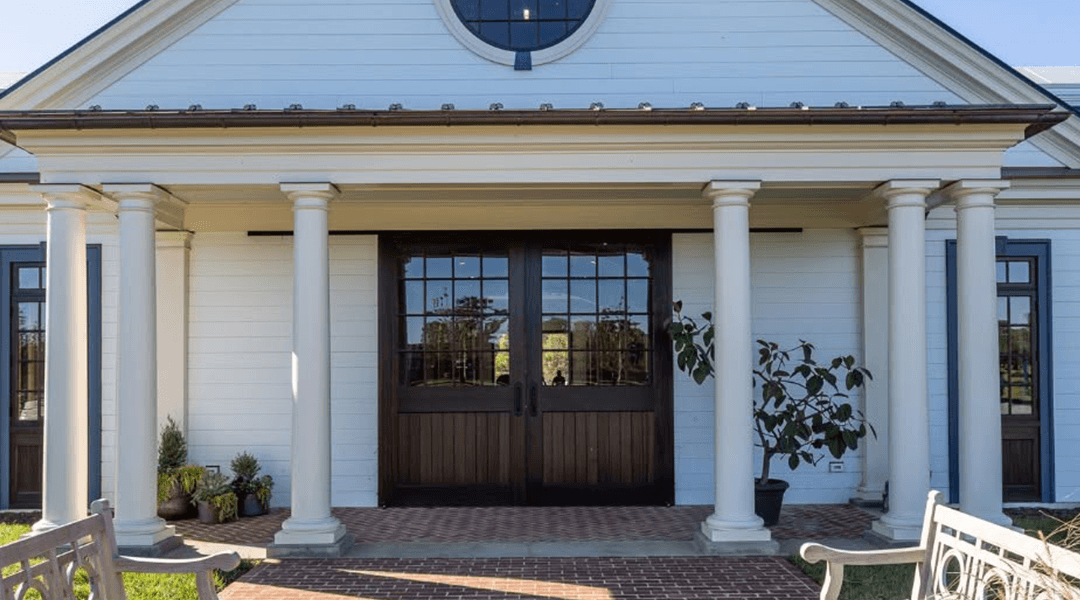
Every exterior door is an opportunity to elevate a project’s design and performance. The right wood species delivers a rich color, distinctive grain, timeless character, and the durability to withstand decades of weather exposure. Architects and builders who understand wood’s unique properties can confidently specify doors that enhance both curb appeal and long-term value.
Wood exterior doors offer a classic, elegant look that can significantly enhance a building’s curb appeal. Find the best wood for your front door in this guide.
What Is the Best Wood for Exterior Doors?
Selecting the best wood species for exterior doors requires balancing aesthetics with measurable performance. Five species offer distinct advantages across color, grain character, and three critical durability metrics.
1. Sapele Mahogany
Sapele mahogany is the premium wood for single or double-entry doors, offering visual drama and long-term stability. This African tropical hardwood ranges from golden to rich reddish-brown and dark-brown tones, darkening with age.
One of sapele’s most distinctive features is its interlocked grain, which can appear as ribbons, stripes, or pommele — a rounded, bubble-shaped graining that creates depth across the surface. This grain structure produces chatoyance, a shimmering effect where the wood appears to change color and reflectivity as light moves across it.
Sapele mahogany’s performance credentials match its visual appeal with outstanding metrics:
- Janka hardness: Janka hardness measures a wood’s resistance to denting and wear, expressed in pounds-force (lbf). Higher numbers indicate harder, more dent-resistant wood. With a hardness of 1,410 lbf, sapele provides excellent dent resistance.
- Decay resistance: The wood’s rot and decay resistance ranges from moderately durable to very durable.
- Dimensional stability: Dimensional stability refers to how much wood shrinks or swells in response to changes in moisture, measured as a percentage across three planes — radial, tangential, and volumetric. Lower percentages indicate better stability and reduced warping risk. Measurements show radial shrinkage of 4.8%, tangential shrinkage of 7.2%, and volumetric shrinkage of 12.2%, demonstrating excellent stability that minimizes seasonal movement.
2. White Oak
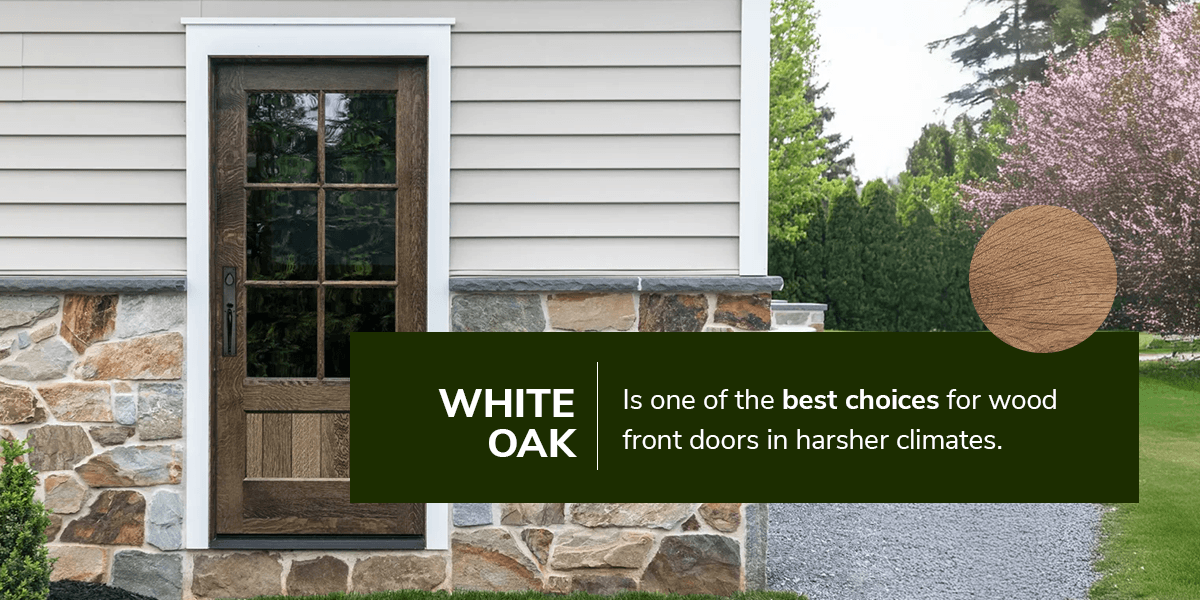
White oak brings centuries of proven performance to exterior door applications. This Eastern and Central North American hardwood ranges from light to medium brown, often with subtle golden undertones. It showcases a tight, uniform grain texture with straight and arched patterns.
Below are its typical durability metrics:
- Janka hardness: At 1,360 lbf, white oak rivals sapele’s wear resistance.
- Decay resistance: Tyloses — cellular structures that block moisture penetration — give the wood exceptional decay resistance, earning it a very durable rating. This structure makes white oak one of the best choices for wood front doors in harsher climates.
- Dimensional stability: Shrinkage measures 5.6% radially, 10.5% tangentially, and 16.3% volumetrically. Proper construction methods can help prevent seasonal movement due to higher tangential shrinkage.
3. Western Red Cedar
Western red cedar has exceptional rot resistance despite being the softest species on this list. Native to coastal regions from Alaska to California, this Western North American wood ranges from light pinkish-brown to deep reddish-brown hues, darkening naturally with age. The grain runs straight and even.
Here’s how western red cedar performs according to durability metrics:
- Janka hardness: Despite being rot- and decay-resistant, it has a Janka hardness of just 350 lbf.
- Decay resistance: Natural oils that repel moisture and insects give cedar durability ratings of durable to very durable.
- Dimensional stability: This wood delivers the best dimensional stability of the five species, with radial shrinkage of 2.4%, tangential shrinkage of 4.8%, and volumetric shrinkage of 7.3%.
Outstanding dimensional stability and natural rot resistance make cedar ideal for wood entry doors in high-moisture environments. Its softness remains a limitation as the wood dents easily, making it better suited for protected entries or applications where a weathered patina complements the design.
4. Douglas Fir
Douglas fir has a reputation as the reliable workhorse in architectural millwork. This Western North American species displays a light reddish-brown to yellowish-brown color. Quartersawn pieces show straight, plain grain, while flatsawn lumber reveals wild patterns that add visual interest.
The species performs moderately across all durability metrics:
- Janka hardness: It provides reasonable dent resistance, with a Janka hardness of 660 lbf.
- Decay resistance: Decay resistance rates are moderately durable.
- Dimensional stability: The wood shrinks 3.6% radially, 6.3% tangentially, and 9.9% volumetrically, offering respectable stability that falls between cedar’s excellent numbers and oak’s higher movement.
Douglas fir’s strength-to-weight ratio and proven reliability make it an excellent, cost-effective choice for exterior doors. However, the moderately durable decay rating makes the finish critical, as proper sealing and maintenance are nonnegotiable for longevity.
5. Poplar
Poplar, which grows across North America, Europe, and Asia, is one of the best wood options for painted exterior doors. It offers a subtle grain pattern and smooth surface, shifting the focus from wood character to color and architectural detailing.
Performance reflects its intended use:
- Janka hardness: At 540 lbf, Janka hardness provides moderate wear resistance.
- Decay resistance: The wood lacks natural decay resistance, requiring protective finishes for exterior applications.
- Dimensional stability: The wood shrinks 3.7% radially, 7.6% tangentially, and 11.8% volumetrically.
Poplar is a cost-effective choice for entry door projects with painted finishes. When properly sealed, it delivers reliable performance at a lower price point than premium hardwoods.
The Importance of Construction
While it is important to select the best wood for entry doors, construction methods ultimately determine whether your wood selection performs as intended. Superior construction separates architectural-grade doors from commodity products.
Engineered Doors
A solid piece of wood does not make the best finished product. Purposeful engineering ensures your doors operate smoothly from day one and maintain that performance for decades. Cross-grain construction stabilizes the door against moisture fluctuations, eliminating the warping and gapping that compromise both function and appearance. Doors open and close effortlessly season after season, with no binding, sticking, or gaps that let in drafts.
This stability comes from alternating grain directions within the door’s core. When humidity rises, the perpendicular grain of adjacent layers counteracts expansion, keeping the door dimensionally consistent. When conditions dry, the same cross-grain structure prevents excessive shrinkage.
Sawing Method
How you cut lumber affects its performance. Plain-sawn cutting — sawing straight through the log with parallel cuts — yields wide boards efficiently but exposes wood to greater seasonal movement.
Quartersawn cutting involves first dividing the log into quarters lengthwise, then sawing each quarter with growth rings oriented perpendicular to the board’s face. Quartersawn lumber resists cupping, twisting, and dimensional change far more effectively, delivering the stability that exterior applications demand.
Professional Benchmarks
Industry standards provide objective benchmarks for door quality. Reputable manufacturers follow the specifications of the Architectural Woodwork Institute (AWI) and the Window and Door Manufacturers Association (WDMA).
The AWI 300 standard establishes baseline requirements for exterior lumber, including rot resistance or preservative treatment. These standards address wood species, moisture content, grain orientation, joinery methods, and finish requirements. Confirming AWI and WDMA compliance when specifying doors ensures that the product meets professional standards.
Partner With Vintage Millwork & Restoration for Enduring Quality
Vintage Millwork & Restoration has over 20 years of experience crafting custom exterior doors for architects, builders, and contractors. We offer some of the best wood for exterior doors, including sapele mahogany, rustic white oak, western red cedar, and Douglas fir. We quartersaw our lumber and purposefully engineer our doors for lasting performance.
Our fully custom doors offer unlimited design freedom. Whether sapele mahogany for a signature entry or western red cedar for coastal applications, our team provides the expertise and partnership your projects deserve.
Ready to start your next project? Complete our online form or call 717-832-9305 to discuss your specifications.